Comms watchdog
A unit that goes silent for 20 s drops to COMMS_DEGRADED and is braked. It needs 8 s of continuous uplink before it may move again.
Trisphere · Aram OS
Aram is the coordination kernel for machines that work in the field: tractors, rovers and drone swarms. It runs on hardware you own, keeps every machine inside its fence, and fails safe when the radio goes quiet.
01 The kernel
Operators, safety logic and hardware drivers meet in a single process at the edge. Swap the machine underneath and the mission, the fence and the audit trail stay the same.
Several kernels can coordinate as a swarm over mutually authenticated links, so a fleet can span fields, sites or teams.
02 Missions
The same kernel runs a working farm, a coordinated swarm or a rover on a workbench. Each mission has a status label, and we don't claim more than we've built.
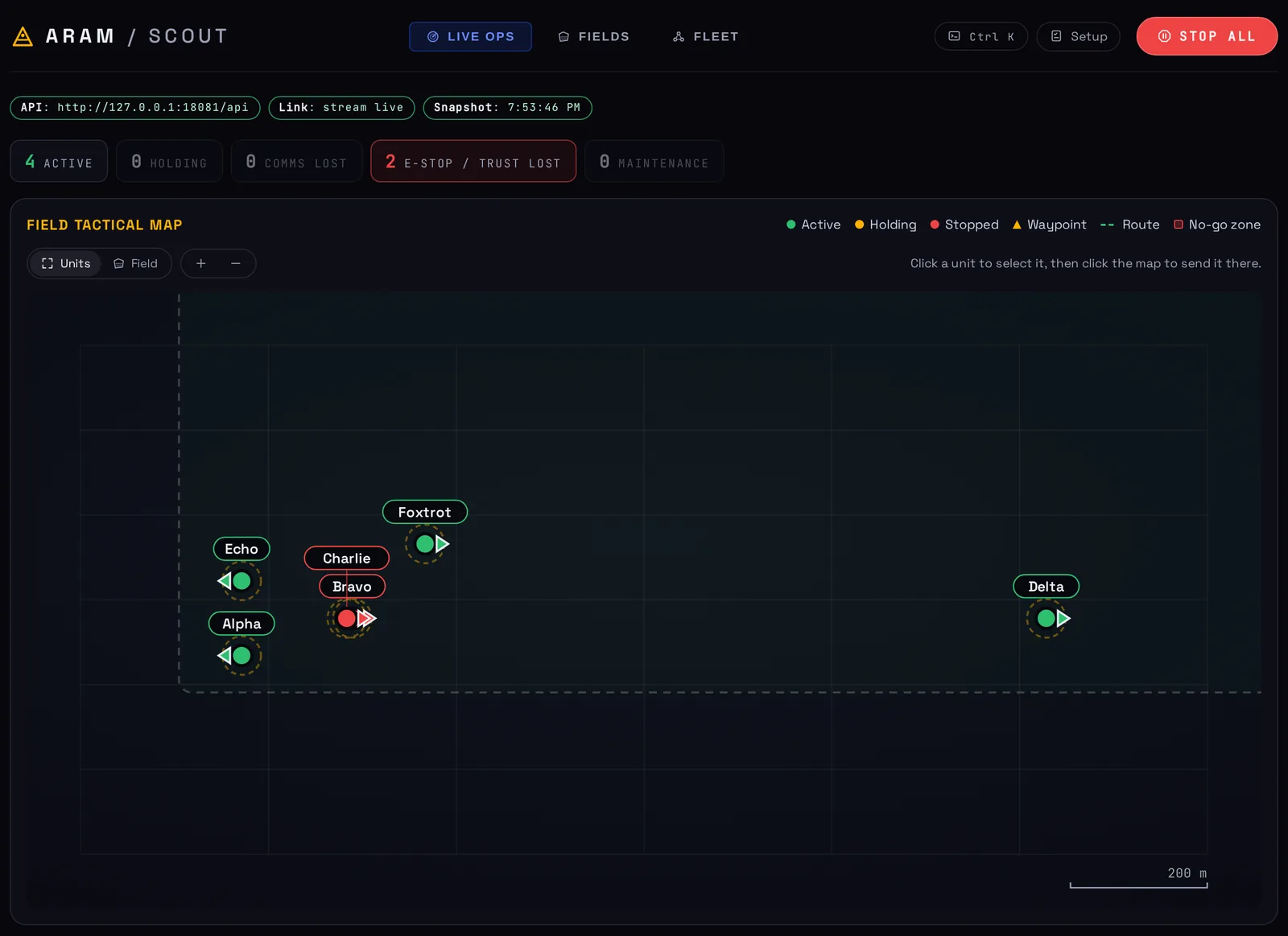
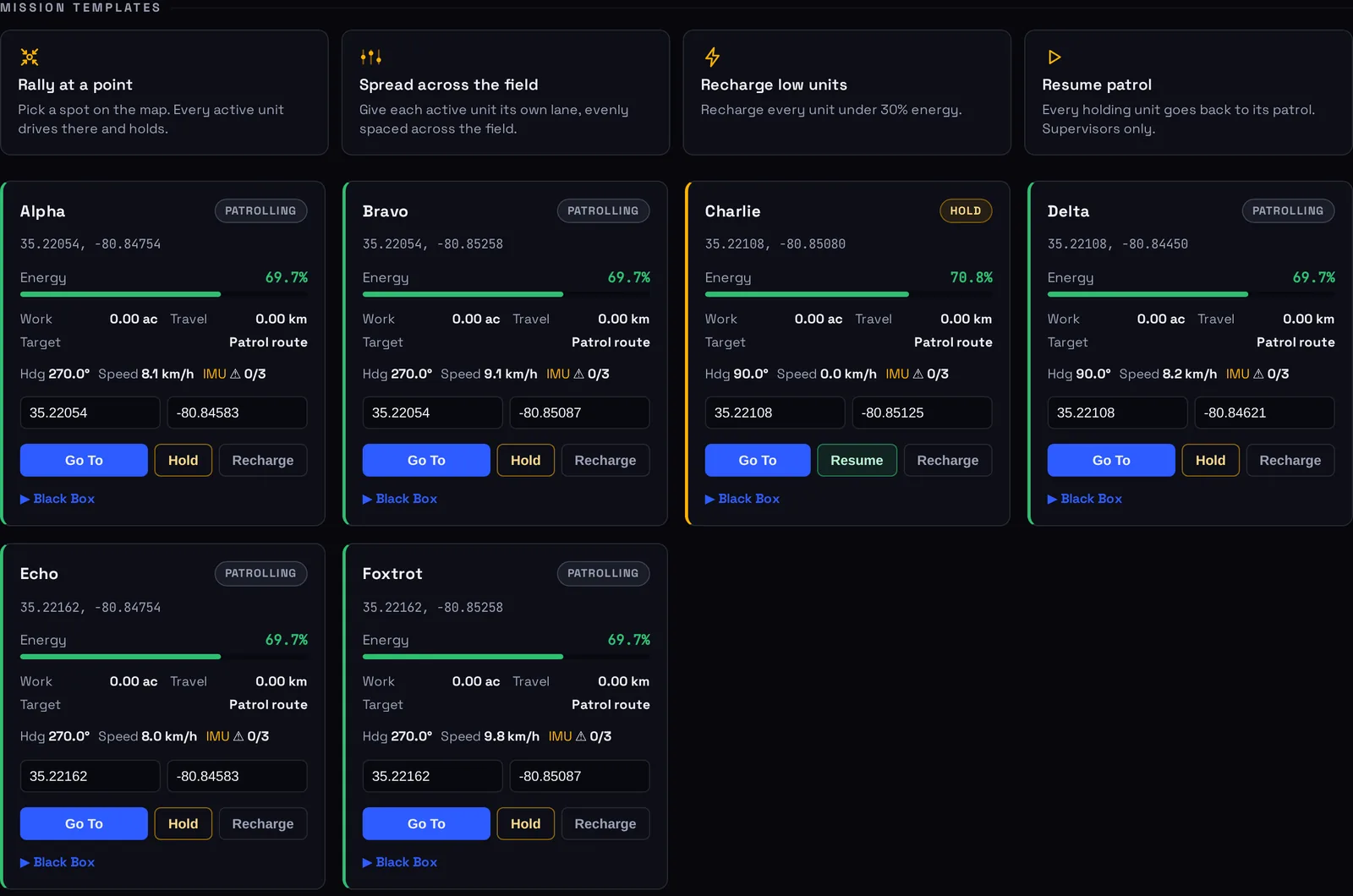
Plan the work, set the fence, and let a fleet run its rows. Aram tracks every unit's state, brakes anything that loses contact, and records who commanded what.
Many machines, one picture. Kernels share missions over mutually authenticated links, so search patterns, formations and light shows can be planned once and run together.
Start with an RC car, an ESP32 and a GPS module. The free demo license runs two units, and the fleet simulator stands in for machines you don't have yet.
03 Safety architecture
Machines that move need a kernel that assumes the worst. These behaviours are enforced in code, not left to operating procedure.
A unit that goes silent for 20 s drops to COMMS_DEGRADED and is braked. It needs 8 s of continuous uplink before it may move again.
A brake command is retried 3 times, 200 ms apart. If the hardware still doesn't confirm it, the unit escalates to EMERGENCY_STOP. Leaving that state takes an explicit maintenance or hold step.
Containment uses spherical (S2) geometry for a hard stop at the fence, with a buffer zone that warns before a unit gets there.
Every API call carries a Keycloak token or an HMAC request signature, and signing keys rotate without downtime. Roles run from observer to admin, and each role is limited to what it may command.
A built-in certificate authority issues each machine its own identity. Hardware check-in requires mutual TLS, and check-ins are rate-limited per unit.
Every command is logged with its actor, role, source, outcome and reason, and the database is backed up on a schedule.
04 Specifications
| Runtime | Single Go binary on Linux · SQLite (WAL) · systemd service |
|---|---|
| Connectivity | Runs fully on site. Cloud sync is optional and licenses verify offline. |
| Hardware drivers | Serial over ESP32 bridge (BNO055 IMU, BN-880 GPS, PWM servo/ESC) · SAE J1939 / ISOBUS over SocketCAN · Simulation |
| Operator clients | Browser HUD · Flutter Scout tablet (Android, iOS) · JSON HTTP API |
| Identity & access | OpenID Connect with PKCE (Keycloak) · HMAC request signing with key rotation · Role-based actors |
| Device trust | Built-in CA · Mutual TLS for hardware check-in · Per-unit rate limit (default 10/s) |
| Safety timers | Comms loss 20 s · Recovery 8 s · Brake retry 3 × 200 ms → EMERGENCY_STOP |
| Geofence | S2 spherical containment · Hard stop and buffer warning zone |
| Licensing | Ed25519-signed keys · Demo 2 units · Starter 3 · Pro 10 + cloud sync · Enterprise unlimited + swarm |
| Pricing | Scoped per deployment: the kernel, the hardware it drives and the support around it. Request a briefing for a quote. |
05 Engage
Briefings for agencies, operators and integrators. Demo licenses for builders. Responsible disclosure for researchers.
More from Trisphere: Bunnie · Vandelay · Lenz · SheekBot · All products
© 2026 Trisphere · Aram OS is in preview